Build railways, run trains and watch small towns grow into busy cities.
Coming soon
In closed testing on Google Play. This page will link to the store listing when it goes public.
What it looks like
About the game
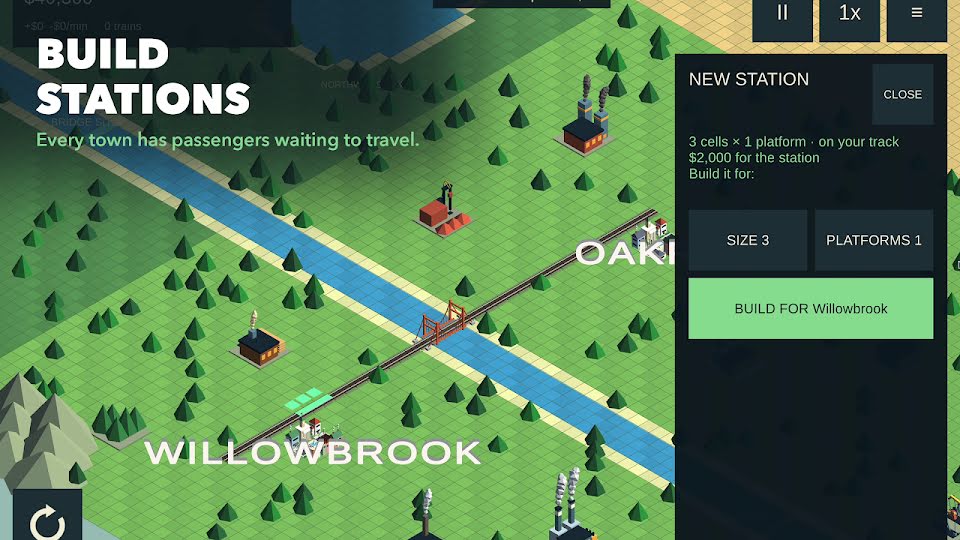
Lay your first track across a quiet valley and watch it come alive.
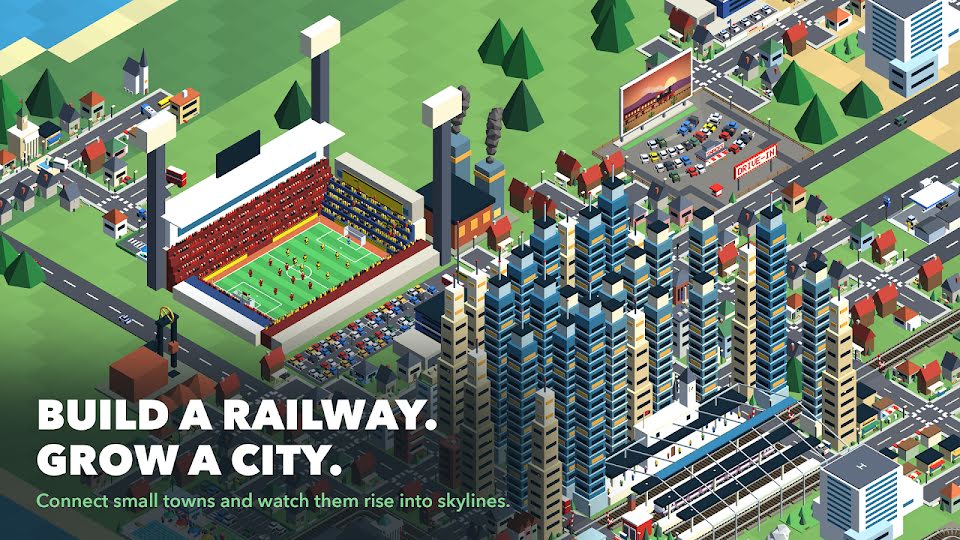
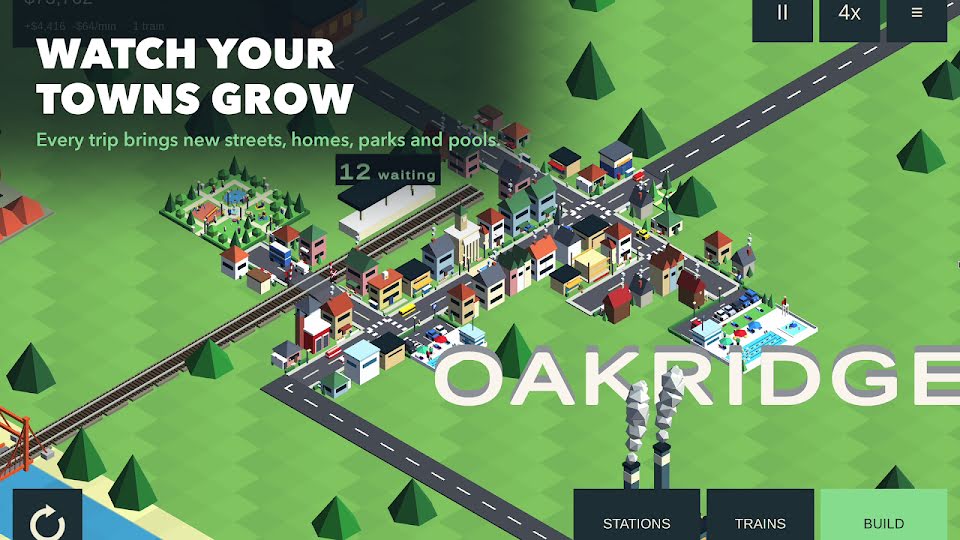
Valley Rail starts with a handful of small towns and no trains at all. Build a railway between them, put a station at each town, buy a train and send it on its way. Every trip earns money and brings new people, and your towns begin to grow: new streets and homes, then parks and pools, office blocks and a skyline of towers.
HOW TO PLAY
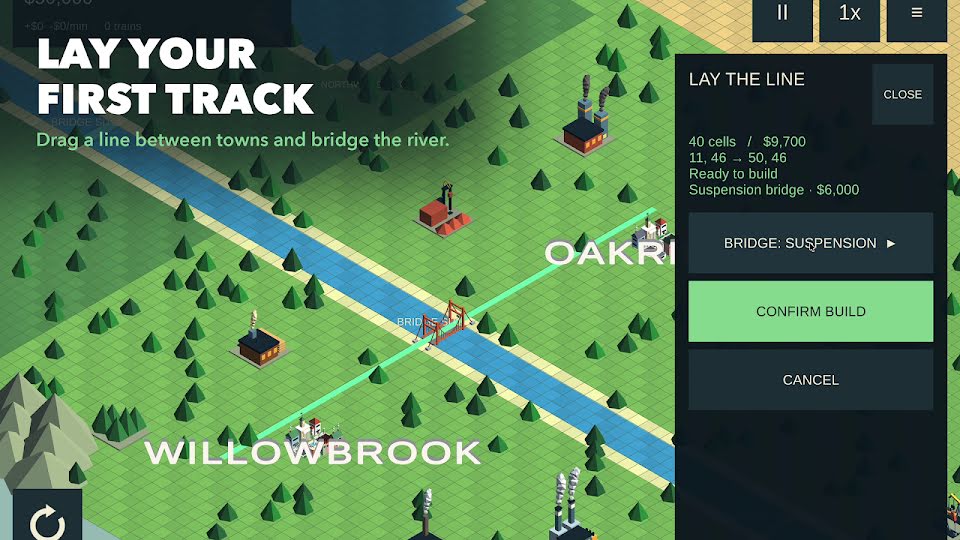
Drag a track from town to town, and cross the river on a bridge in one of five styles.
Build a station beside a town or an industry and watch passengers and cargo gather.
Buy a train, choose where it goes, and it runs the route on its own.
Reinvest what you earn, or give a town a gift to make it build even faster.
A VALLEY THAT GROWS WITH YOU
Towns grow from small villages into large cities as your trains serve them.
Cities build stadiums with live football matches, universities, parks, pools and a zoo.
Sunny beaches by the sea, ski resorts in the snowy peaks and a drive-in cinema.
Cars, buses and emergency vehicles fill the streets, and towns build roads to each other.
TRAINS AND FREIGHT
Six train models for passengers and freight, from a one-coach commuter to a streamlined express.
Carry coal, wood, oil, iron ore, steel and goods between mines, forests, oil wells, mills and power stations.
Rail crossings with automatic signals.
Light rail that takes the fans from the station straight to the stadium.
PLAY AT YOUR PACE
Pause any time, or speed time up to 2x or 4x.
Plays offline and saves automatically.
Relaxing music: sixteen classical pieces, arranged for the game.
A diesel-electric train runs a generator and traction motors; an electric train draws power from overhead wire (1.5 kV or 3 kV DC, 15 kV 16.7 Hz or 25 kV 50 Hz AC) or a 750 V DC third rail. Higher voltage means less current for the same power.
Adhesion between steel wheel and rail is roughly a tenth to a third of the weight pressing down, against about 0.7 for rubber on dry road. With service braking near 0.7 m/s², distance is v² ÷ 2a: about 800 m from 120 km/h.
Trams share streets and drive on sight, so they brake hard, use low-voltage overhead lines (typically 600 to 750 V DC against 25 kV AC on UK main lines), take tight curves and steep gradients, and weigh less per axle. Main-line trains rely on signals because they cannot stop within sight.
A crossing detects trains with track circuits, axle counters or treadles. The detector sits far enough up the line to give the warning time the road needs, found by multiplying speed by time. The design is fail-safe: loss of power means barriers down.
Local solar time shifts by 4 minutes for every degree of longitude, so Bristol runs about 10 minutes behind London and Penzance about 22. Railways adopted London time from 1840, and the rest of Britain and North America followed.